
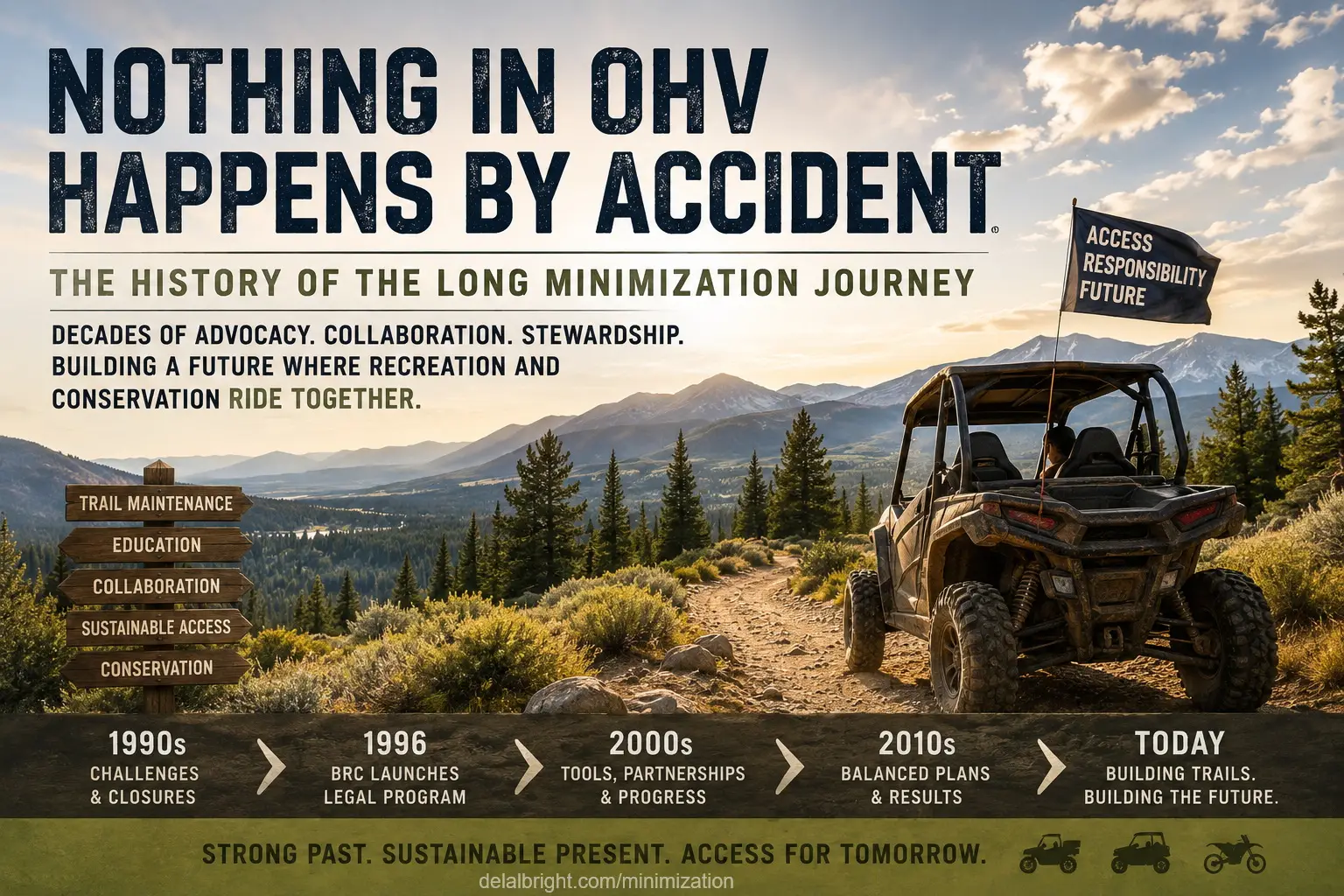
Nothing in OHV/Motorized Recreation Happens by Accident
### By Del Albright
As a former Executive Director and Ambassador for the BlueRibbon Coalition, I was on the ground floor of developing the minimization concept and working with special interest groups to find common ground for OHV management on public lands. Back in the 1990s, countless hours spent “at the table” by Paul Turcke, Don Amador, and the entire BRC legal team helped build an unequaled foundation at the time. There is far more to this story than many people realize today.
For many in today’s OHV community, it is difficult to imagine just how hostile the public land management climate was toward motorized recreation during the early and mid-1990s. At the time, the prevailing view among many environmental organizations — and even some career agency staff — was that the “minimization criteria” contained in Executive Orders 11644 and 11989 were primarily intended to justify widespread closures of roads, trails, and riding areas on federal lands.
Recognizing the long-term threat to motorized access, the BlueRibbon Coalition created the first national grassroots OHV-specific legal program in 1996. Its purpose was to address and mitigate the misuse of minimization criteria as a one-way closure mandate. That groundbreaking in-house legal program worked alongside other attorneys, national organizations, state associations, and local clubs to defend travel management plans, participate in rulemakings, submit technical comments, engage elected officials, and intervene in litigation involving federal land access.
Minimization Was More Than Closures
Rather than accepting the argument that minimization automatically meant closures, the legal team successfully advanced the idea that sustainable recreation management could include a wide range of practical tools designed to reduce impacts while still maintaining access. Through years of administrative engagement, collaboration, and litigation, agencies gradually began recognizing that minimization could include trail maintenance, reroutes, bridge crossings, hardened stream crossings, trail delineation, education programs, signing, maps, seasonal restrictions, law enforcement, monitoring, restoration projects, and adaptive management strategies.
By the early 2010s, those efforts began producing measurable results. Some Forest Service units began developing far more robust “minimization chapters” within travel management documents that demonstrated how recreation access and resource protection could coexist.
Today, many federal land managers routinely utilize a diverse “minimization toolbox” that includes active management techniques rather than defaulting solely to closures. Using the toolbox developed over the last 30 years, a growing number of public land units and agencies are now constructing, rerouting, and formally designating new OHV trails and sustainable route systems specifically designed for modern recreation demands and long-term environmental durability.
Recent Executive Orders
The recent debate surrounding President Trump’s repeal of the old minimization executive orders highlights just how much the conversation has evolved over the past three decades. While opinions differ regarding the best direction for future policy, it is important for the OHV community to recognize that today’s recreation management framework did not happen by accident. It was the product of decades of advocacy, partnership building, legal engagement, and a commitment to proving that managed recreation and conservation are not mutually exclusive.
The most effective voices within the OHV community understood early on that long-term access would never be secured through rhetoric alone. Sustainable access required stewardship, credible participation in public processes, investment in trail systems, and a willingness to engage constructively with agencies — and even with longtime opponents.
While many advocates believe minimization criteria continue to be applied inconsistently and remain a source of controversy, the broader lesson remains unchanged: long-term access depends on stewardship, participation, and constructive engagement.
As the next generation of federal travel management policies begins to emerge, that lesson remains just as important today as it was back in the 1990s. The future of OHV recreation on public lands will continue to depend on maintaining a strong culture of responsible use, sustainable management, and collaborative engagement that protects both recreation opportunities and the landscapes that make those opportunities possible.
Link to Executive Order removing restrictions to public lands