Understanding Capacity Closures, Carrying Capacity, and Visitor Capacity
By Del Albright
Over the years, I’ve written a lot about road closures, capacity, trail closures, travel management, route designation, wilderness, and access issues on public lands. Most of us in the outdoor recreation community know what a closure looks like. A gate across a road. A trail marked “closed.” A campground shut down.
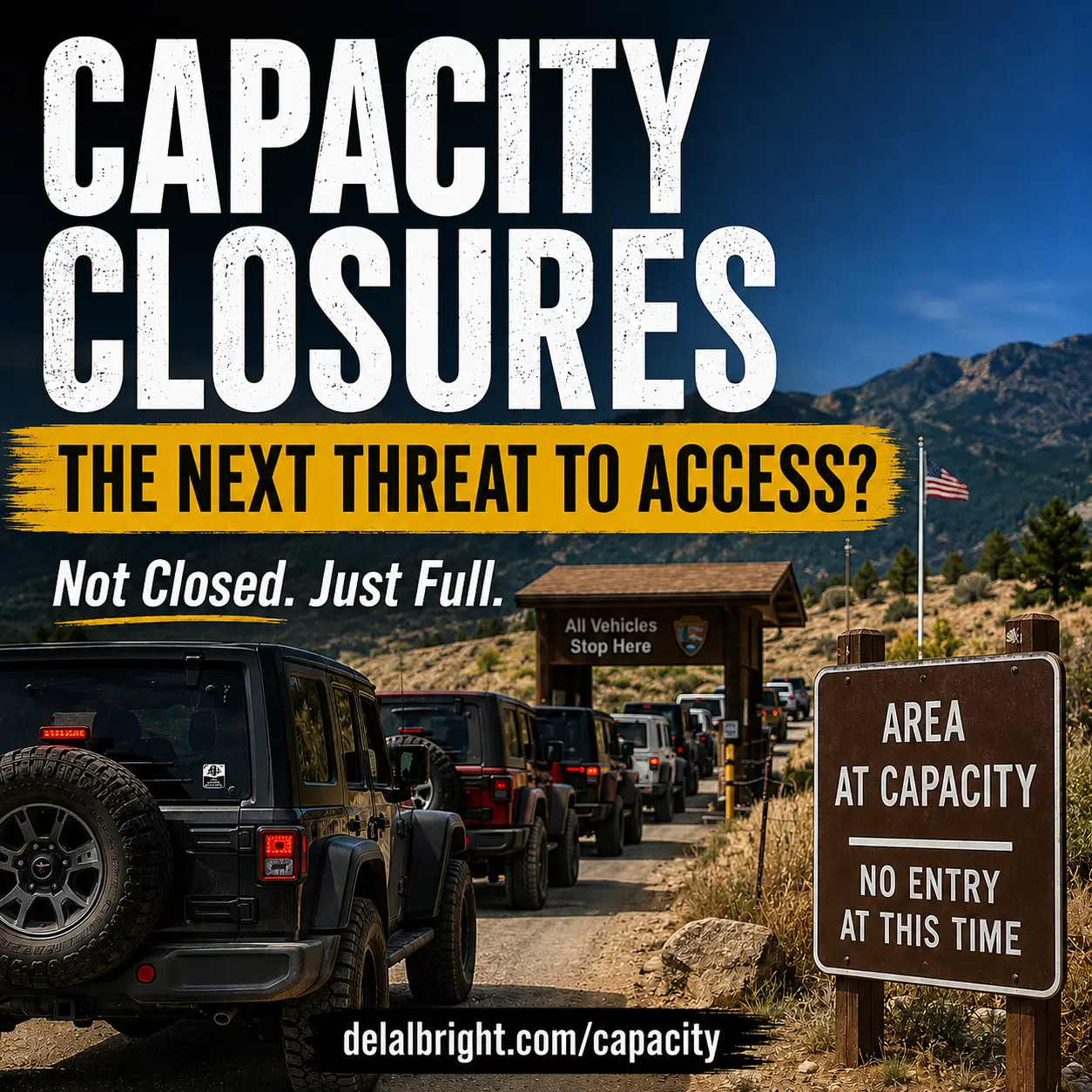
But there is another management concept quietly gaining traction across public lands that deserves our attention and understanding. It’s called visitor capacity management, and in some situations, it can lead to what many people are beginning to call capacity closures.
Before anyone gets excited, let’s be clear about something. This is not a conspiracy theory. It is not a secret plan. It is not necessarily a bad thing. It is a real and growing public land management tool that recreationists should understand because it has the potential to influence access for years to come. And for decades, most all powersports events on either public or private land have had capacity or rider/driver limits. So, let’s break down what this means for the future of public land access.
What Is a Capacity Closure?
In simple terms, a capacity closure occurs when an area reaches a predetermined limit for visitors, vehicles, campsites, permits, parking spaces, boats, OHVs, or some other measure of use. Once that limit is reached, additional visitors may be turned away, delayed, required to obtain a reservation, or denied access until usage drops below the established threshold.
(Insider note: there was a time when the Rubicon Trail was threatened by capacity limits and closures — too many users, too much “poop” on the trail, and too much crowding of popular spots – early 2000s. That’s when Friends of the Rubicon was formed to fix the problems. They did. No capacity closures occurred. But who knows what the future holds.)
In many cases, you won’t even see the words “capacity closure.” Instead, you may hear terms like:
* Visitor capacity
* Visitor use management
* Carrying capacity
* Timed entry
* Reservation systems
* Occupancy limits
* Use quotas
* Vehicle limits
* Permit systems
Different agencies use different terminology, but the underlying concept is similar: managing how many people can use an area at a given time.
Why Are Agencies Using Capacity Management?
To be fair, there are legitimate reasons. Public land visitation has exploded in recent years, particularly since the scare of 2020. National parks alone recorded hundreds of millions of visits annually, placing increasing pressure on parking lots, roads, campgrounds, staff, facilities, and visitor services. Land managers often cite several objectives:
* Protecting natural and cultural resources
* Improving visitor experiences
* Reducing congestion
* Improving safety
* Matching use levels to available staffing and infrastructure
* Preventing damage caused by overcrowding
The federal Interagency Visitor Use Management Council, which includes agencies such as the Forest Service, the National Park Service, the BLM, and others, has developed formal frameworks to help managers determine appropriate visitor-use levels and management strategies. In many cases, capacity management is intended to keep an area open rather than close it outright. That’s an important distinction. But the “closed” or “full” sign in the parking lot of your favorite boat launch, staging area, or trailhead is never a welcome sight.
This Isn’t Entirely New
The concept actually has deep roots in public land management. For decades, wilderness areas, backcountry destinations, river systems, and certain national parks have used permit systems and visitor quotas. Managers have long discussed concepts such as carrying capacity, Limits of Acceptable Change (LAC), and Visitor Experience and Resource Protection (VERP) when addressing crowding and resource impacts.
What is new is how broadly these concepts are now being applied. Today we see timed-entry systems, reservation requirements, parking management programs, vehicle quotas, and other visitor-use controls appearing in more recreation settings than ever before. It worries me how many terms we can find for closures or visitor restrictions.
The Questions Recreationists Should Be Asking
As advocates for responsible outdoor recreation, I don’t believe the answer is to automatically oppose every capacity management proposal. But I do believe we should ask good questions. Questions such as:
* How was the capacity determined?
* What data supports the number?
* Is the limitation based on resource protection, infrastructure, staffing, or visitor experience?
* Is the limit temporary or permanent?
* What monitoring will occur?
* Can the capacity be adjusted if conditions improve?
* Does the proposal unnecessarily restrict public access?
Those are fair questions. After all, public lands belong to the public. When access is limited, even for legitimate reasons, the public deserves transparency and accountability in the decision-making process.
A Trend Worth Watching
One observation seems increasingly clear. For many years, the default approach was often: Open unless signed closed. But, in some locations, management is evolving toward: Open, but managed by capacity. And of course, many of you heard over the years: Closed, Unless Signed Open. We must pay attention to the little things…
That shift may occur through reservations, permits, vehicle limits, parking controls, timed entry, or other tools. The result, however, can feel very similar to a closure when an area reaches its allowable capacity — carrying capacity. Whether that trend ultimately benefits recreation or creates new barriers to access will likely depend on how responsibly agencies implement these programs and how actively recreationists stay involved in the conversation. We must stay engaged! We must be part of the solutions.
Final Thoughts
I’ve spent much of my life working around public lands, from wildland fire and resource management to recreation advocacy and volunteer stewardship. One lesson I’ve learned is that most public land issues are rarely black-and-white. Capacity management is no exception.
In some places, it may help protect resources and improve recreation opportunities. In others, it could become a tool that unnecessarily limits public access if not carefully justified and monitored. That’s why I believe this is a topic worth paying attention to. Not because we should panic, and not because we should oppose every proposal. But because informed citizens and responsible recreationists have always been the best guardians of both access and stewardship. To be the best guardian you can be, JOIN those groups you believe are working to preserve responsible access to public lands!
As this conversation continues across our public lands, we would do well to remember that protecting access and protecting resources are not opposing goals. Done right, they should work together.
_______________________________
Bottom Line:
Watch the details. Ask questions. Stay engaged. Join/renew your organizational memberships of those groups keeping an eye on things. Capacity management may become one of the most important public-land access discussions of the next decade.
Interagency Visitor Use Management Council