
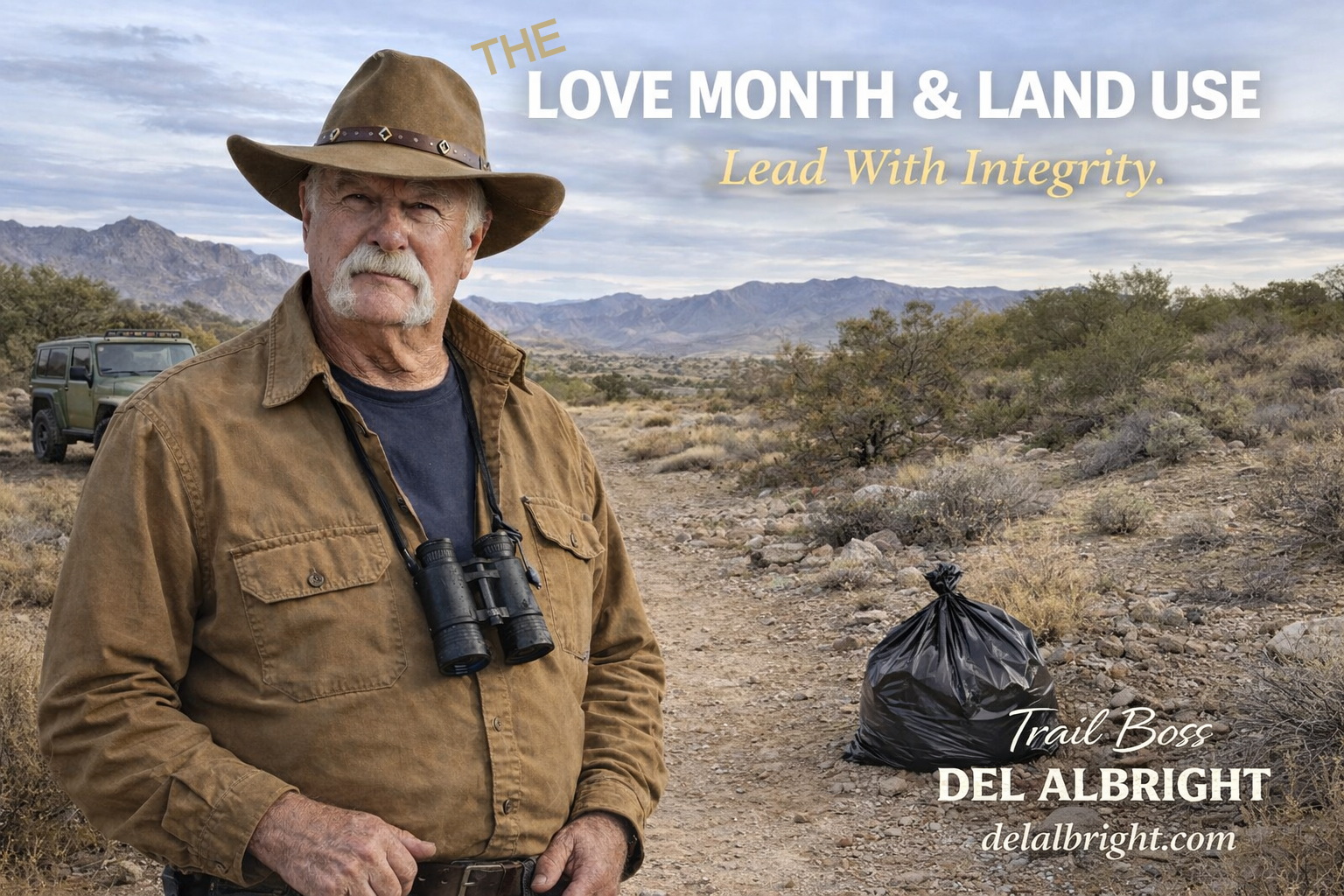
An Essay About the “Love Month” and Land Use
By Del Albright
February gets called the “love month.” With Valentine’s Day, longer days ahead, and maybe even a little sunshine breaking through winter, there’s a lot we’re encouraged to celebrate.
Love is a word we use easily when we talk about family, faith, and friendships. But when it comes to land use and public access, love isn’t a word we reach for very often.
We say we love our recreation — and we do. But what about loving the people who oppose it? That’s where things get complicated.
This isn’t a sermon about “turning the other cheek.” It’s about something more practical — and more foundational.
Integrity.
In this blog — and in everything I advocate for on behalf of public lands — integrity is the starting point. It shapes how we defend access, how we hold ourselves accountable, and how we deal with those who disagree with us.
Years ago, I heard a simple idea that stuck with me: You can love someone without loving what they do. That distinction matters. And in today’s land use climate, it may matter more than ever.
Let’s dig into that.
Loving the Fight (Without Hating the People)
In the world of public lands, we deal with disagreement constantly with things like:
Groups that oppose motorized recreation
Advocates who use questionable science
Well-funded campaigns that push closures
Volunteers who are passionate—but misinformed
The easy reaction is anger. The harder response is discipline. But however you look at it, questions arise like:
Can we stand firm without becoming bitter?
Can we push back without becoming personal?
Can we defend access without losing our character?
Those aren’t soft questions. They’re leadership questions.
Holding Our Own Accountable
Let’s talk about something even harder: our own side.
We’ve all seen it:
Trash left behind.
Historic artifacts stolen or vandalized.
Trails widened.
Rules ignored.
Years ago, someone hauled off heavy iron ore carts from an old desert mining site in Southern California. That wasn’t mischief—that was effort. And it robbed future generations of a chance to see a piece of history. We hear about stupidness like this often where vandalism or bad behavior were someone’s idea of fun.
When our own peers behave badly, it hurts twice as much. Because it damages the very cause we’re fighting to protect. So what do we do?
First off, we don’t stay silent. We correct. We educate. We set expectations. And we always set the example (see below for more on this). Some might call this “quiet leadership.” Quiet leadership isn’t always comfortable—but it’s necessary.
Forgiveness vs. Accountability
Forgiveness sounds good. Love sounds noble. But forgiveness doesn’t mean ignoring damage. And love doesn’t mean surrender. It’s complex, but in simple terms here is where I stand:
I believe in compromise—when the benefits are mutual.
I believe in coexistence—with those willing to meet halfway.
I believe in partnerships—with those acting in good faith.
But compromise for the sake of compromise? That’s not leadership. That’s drift. Every disagreement requires both sides to give something—or there is no middle ground.
Case by Case
This has not been an easy path, but here’s where I’ve landed over the years:
Evaluate people and groups individually.
Don’t rely on rumor or stereotypes.
Give folks a fair chance—at least once.
But don’t ignore patterns of bad behavior.
If someone cheats you, breaks agreements, or violates trust—address it directly. Calmly. Clearly. Head on.
Leadership in land use isn’t about liking everyone. It’s about standing for something. It’s about being clear on the example you set.
The Real Meaning of the “Love Month”
If February is the love month, maybe this is what that means for those of us involved in land use and keeping trails open:
Love your recreation enough to protect it.
Love public lands enough to steward them.
Love future generations enough to set the example.
Love your community enough to hold it accountable.
Don’t just let things happen around you. Make something happen. Get involved—at whatever level your time allows. Speak up when something’s wrong. Stand firm when it matters.
Public access doesn’t sustain itself. It survives because people care enough to act. And that, in my book, is a form of love.
— Del Albright