
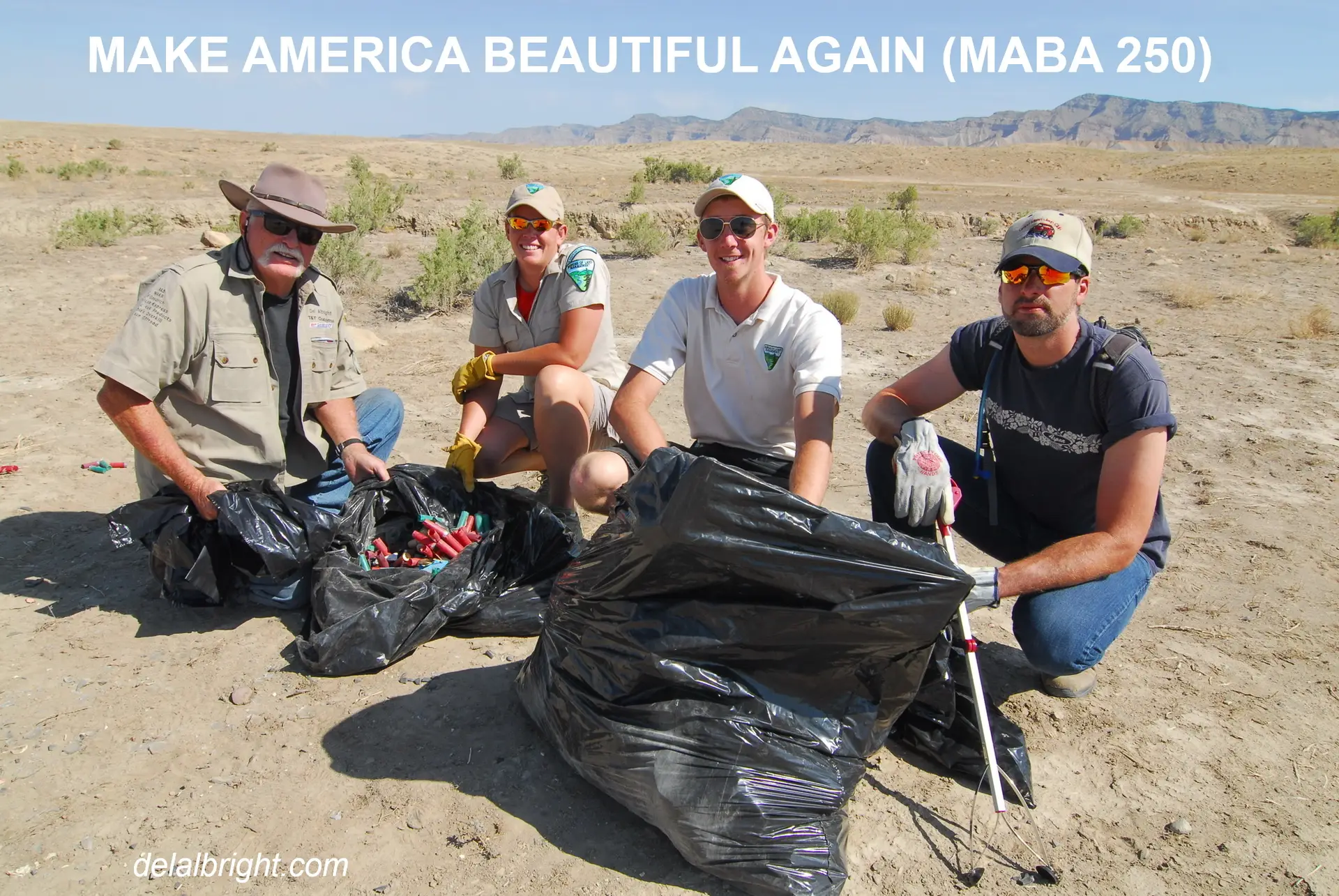
MABA – Make America Beautiful Again, Outdoor Recreation Insight
How MABA, DOI Red-Tape Reform, and Federal Priorities Drive Outdoor Access
By Del Albright, Advocate for Responsible Outdoor Recreation
Executive Summary
Recent federal initiatives under President Donald J. Trump are reshaping the landscape of public-lands management, regulatory reform, and voluntary conservation efforts. For the outdoor industry—from gear manufacturers and guide services to recreation destinations and advocacy groups—these changes present both opportunities and responsibilities: expanded outdoor access, streamlined project processes, and partnership avenues with grassroots volunteers and conservation efforts.
Federal initiatives under the Trump administration—from executive orders to MABA 250—signal a national emphasis on both economic growth and expanded outdoor access. For businesses in the outdoor industry, this moment presents concrete opportunities to:
- lead conservation efforts
- partner with grassroots volunteers
- catalyze new outdoor experiences for Americans.
By engaging strategically in these initiatives, businesses and volunteer groups can help deliver both environmental stewardship and sustained economic value for communities across the nation.
Recent federal actions and departmental policy updates are being framed as a pro-access, pro-conservation, “cutting red tape” agenda—centered on accelerating permitting and project delivery on public lands, expanding access for recreation (including hunting and fishing), and increasing the pace of forest management and wildfire-related work.
For outdoor-industry, the practical relevance is less about slogans and more about three operational levers that can change the playing field:
First, changes to federal permitting and environmental review procedures (especially those related to NEPA) can affect project timelines, costs, and uncertainty for projects ranging from trail work to events and infrastructure.
Second, the administration’s public lands access posture—paired with major public-land infrastructure needs—creates both opportunity and urgency for industry-aligned stewardship (because access and visitor experience depend on basic maintenance capacity).
Third, the administration is explicitly elevating voluntary conservation—including expanded wildlife migration corridor work and big-game winter range investments—creating a clear lane for businesses to partner with local volunteers and conservation organizations in ways customers can see (and agencies can use).
Make America Beautiful Again Commission priorities and the MABA 250 framework
The commission’s newly launched MABA 250 initiative is described as a “results-driven agenda” intended to conserve natural beauty while expanding recreation opportunities, with an explicit “stewardship and economic growth” balancing frame. It is described as being chaired by the Secretary of the Department of the Interior, Doug Burgum.
The DOI press release lays out priority areas that matter directly to the outdoor economy, including
(1) increase access for hunting, fishing, off-roading, and other forms of recreation,
(2) expand voluntary conservation, and
(3) “cut red tape” that slows conservation and restoration work.
The commission’s establishment is tied in the press release to a July 2025 executive action, and the White House framing explicitly names recreation uses (e.g., hiking, camping, boating, off-roading) as part of the public-land heritage being promoted.
A key “signal paragraph” in the DOI release effectively does four things at once:
It credits the administration’s first-term conservation record, highlighting the Great American Outdoors Act and calling it the largest conservation-policy win since Theodore Roosevelt—a characterization presented as the department’s view.
It describes a second-term priorities package as: more active forest management (including increased timber harvest), fewer bureaucratic barriers to outdoor work, and a greater emphasis on voluntary private conservation.
It links those themes to a concrete resource shift: approximately $8 million being refocused into grant programming for big-game winter range and migration corridors.
It positions MABA 250 as a long-horizon framework (explicitly “over the next 250 years”), essentially inviting non-federal partners—businesses included—to treat stewardship as a durable, repeatable operating practice, not a one-off PR campaign.
U.S. Department of the Interior and partner-agency “red tape” changes affecting projects and permits
The most concrete “red tape” changes described in federal sources fall into two buckets: regulatory review/deregulation initiatives and environmental review/permitting procedure changes.
On the deregulation side, Interior announced a public input process specifically aimed at identifying “outdated, overly complex or burdensome regulations,” tied to a government-wide deregulatory agenda and a “request for information” intended for publication in the Federal Register, plus a dedicated email channel for recommendations from businesses and organizations.
A foundational executive order referenced in Interior’s own materials is E.O. 14154 (Unleashing American Energy). In the Federal Register, it is described as an executive order that includes broad policy language emphasizing the reduction of “burdensome” regulation and the expansion of energy and natural resources development.
The more direct “permitting-and-public-lands” piece is the NEPA implementation reset. Council on Environmental Quality states that E.O. 14154 directed it to propose rescinding its NEPA regulations and provide guidance; it also states that it issued an interim final rule in February 2025 and a final rule in January 2026.
Interior’s February 2026 press release describes a major departmental NEPA overhaul—claiming “final sweeping reforms,” emphasizing red-tape reduction and faster approvals, and describing a shift of most prior procedures into a streamlined departmental handbook.
The DOI final rule (published in the Federal Register) explicitly states that the department is adopting an interim final rule as final; that it partially rescinded DOI’s NEPA regulations; and that DOI will “henceforth maintain the majority” of NEPA procedures in a Departmental Handbook rather than in the CFR—an administrative-structure change that can materially affect how practitioners experience compliance steps.
Separately, a major federal land bureau’s 2025 “accomplishments” roundup explicitly highlights streamlining approaches including adopting categorical exclusions from other agencies and rolling back certain rules to speed up permitting, as part of a broader “cutting red tape” narrative.
A parallel move in the land-management arena is a proposal to rescind the 2024 “Public Lands Rule,” framed by that bureau as necessary to restore “balanced, multiple-use management,” reduce uncertainty, and prevent restrictions on access for uses including recreation.
Stakeholder landscape matters for business planning. National-level news reporting and advocacy organizations describe these changes as legally and politically contested—particularly NEPA rollbacks and forest/logging acceleration—suggesting ongoing litigation risk and reputational volatility around how “streamlining” is implemented.
What “increasing outdoor access” looks like on the ground
The “access” story spans infrastructure funding, rule/permit modernizations, and purposeful expansion of recreation opportunities.
A major structural foundation is the Great American Outdoors Act framework: Interior’s GAOA page describes the act as establishing the National Parks and Public Land Legacy Restoration Fund (LRF) and permanently authorizing funding for the Land and Water Conservation Fund (LWCF). The U.S. Forest Service describes GAOA as investments in infrastructure, recreation facilities, and public-lands access, and explains the two-component structure (LRF plus permanent LWCF funding).
The need-side is stark: the National Park Service reports an estimated $22.986 billion deferred maintenance and repair need at the end of FY2024, emphasizing that addressing it is critical to preservation, accessibility, and enjoyment. The Government Accountability Office notes that the LRF provides up to $1.9 billion annually (FY2021–FY2025) and summarizes how those funds are divided among agencies, while also documenting continued deferred-maintenance challenges.
On the “access expansion” side, Interior released a 2025 press release describing a major proposal to expand hunting opportunities: it announced 42 new proposed hunting opportunities across more than 87,000 acres within the National Wildlife Refuge System and National Fish Hatchery System, framing this as supporting rural economies and outdoor recreation. The same release provides context for how widely hunting and fishing are already permitted across refuges and explicitly ties hunting and fishing to the 1997 Refuge System Improvement Act’s “wildlife-dependent recreation” framework.
Interior also publicized an LWCF-focused action: a 2025 press release announcing a secretary’s order guiding LWCF implementation and stating a record $437,377,607 allocation to states and territories, framed explicitly as expanding outdoor recreation and reducing red tape.
In short, the administration’s “access” posture is being expressed through (a) backlog-funding structures, (b) targeted recreation-policy expansions, and (c) modernization/streamlining of how projects move from idea to ground.
Voluntary conservation: forests, wildfire, and migration corridors
The DOI press release connects conservation credibility, forest health, rural economies, and voluntary private conservation into a single narrative. The policy architecture behind that narrative is most evident in executive orders, wildfire governance reforms, and public–private grant programs.
On forests and timber, E.O. 14225 (Immediate Expansion of American Timber Production) explicitly frames domestic timber production as tied to construction, energy, jobs, forest management, and wildfire risk reduction. It directs Interior and Agriculture to issue guidance on tools intended to speed delivery and reduce uncertainty (including Good Neighbor Authority and stewardship contracting), develop strategies to speed Endangered Species Act consultations for certain forest management projects, and consider adopting categorical exclusions to reduce process length and cost.
On wildfire, E.O. 14308 frames wildfire response as hampered by “unnecessary regulation and bureaucracy” and directs consolidation efforts across federal wildland fire programs, along with expanded partnerships and technology roadmapping. A DOI press release later describes coordinated action to implement E.O. 14308 via creation of a U.S. Wildland Fire Service with an implementation plan, emphasizing bureaucracy reduction and unified response systems.
On wildlife migration corridors, the DOI MABA 250 press release points to a specific financial indicator: approximately $8 million of grant programming being refocused toward big-game winter range and migration corridors. The Western Big Game Seasonal Habitat and Migration Corridors Fund—hosted by National Fish and Wildlife Foundation—describes itself as a multi-partner program aimed at conserving winter range and migration corridors for species such as pronghorn, elk, and mule deer, and it lists participating conservation partners.
That fund is already structured as a public–private partnership vehicle: NFWF’s own press materials describe grants issued through the program and identify federal and private co-funders.
The “meaning” for America is that MABA is pairing an access-first recreation message with an “active management + voluntary conservation” approach, expressed through both policy streamlining and targeted habitat investments.
How outdoor-industry businesses can participate through stewardship and volunteers
The administration’s messaging repeatedly links access and conservation outcomes to implementation capacity—meaning that trail condition, habitat connectivity, and visitor experience are where the “brand impact” will be felt. Those are also the areas where business-supported volunteer work can be most tangible.
Concrete participation pathways that align with federal systems and existing partner models include:
Businesses can directly support volunteer labor on public lands via established federal volunteer programs—such as national parks’ Volunteers-In-Parks program, which explicitly allows volunteering for a day or year-round and emphasizes national availability.
Businesses can help scale involvement through major public-lands volunteer mobilizations; Interior describes National Public Lands Day as the nation’s largest single-day volunteer event for public lands, and the coordinating nonprofit describes training and tools for organizers.
Businesses can support the “keep it open by keeping it cared for” reality by pairing volunteer results with durable partnerships, such as joining/encouraging friends groups and volunteering to improve access, restore ecosystems, and revitalize sites.
Businesses can adopt an ethics-and-stewardship posture that protects future access: federal land managers explicitly promote minimum-impact frameworks, including Leave No Trace, published Code of Outdoor Ethics, TreadLightly!, and highlight responsible recreation guidance.
For motorized and mixed-use communities, ethics education is frequently framed as part of access protection: Tread Lightly! describes partnership options for organizations that want to fund stewardship projects and responsible recreation education.
A practical “business playbook” that tends to resonate with land managers is to treat stewardship like a product launch: define a place and an outcome, resource it, document it, and repeat it. Federal volunteer systems and partner models make it feasible to do this without reinventing governance, tools, or safety protocols.
One important credibility note: multiple public sources emphasize that volunteer capacity is meaningful but not a full substitute for trained agency staffing—so the strongest business stories usually pair volunteer work with partnerships and, where possible, co-funding of durable infrastructure and habitat outcomes (bridges, signage, fencing/barrier modifications, trail rehab, invasive species removal, habitat improvement, and trail sediment reduction).
Outdoor access is a supply chain—and trails, habitats, and public-land infrastructure are the links. Federal policy is moving toward faster project delivery, expanded access, and more voluntary conservation through MABA 250 and related actions. That creates a clear role for outdoor businesses: invest in the places your customers recreate by backing local volunteer stewardship and responsible recreation education. When we help maintain trails, restore habitat, and protect migration corridors, we’re not just “giving back”—we’re keeping access real, safe, and sustainable for the next generation.
NOTE: For those tracking how current federal policy may impact public land access and volunteer partnerships, I’ve outlined recent Executive Orders affecting outdoor recreation here:
More from Cal4wheel on Public Lands Rule