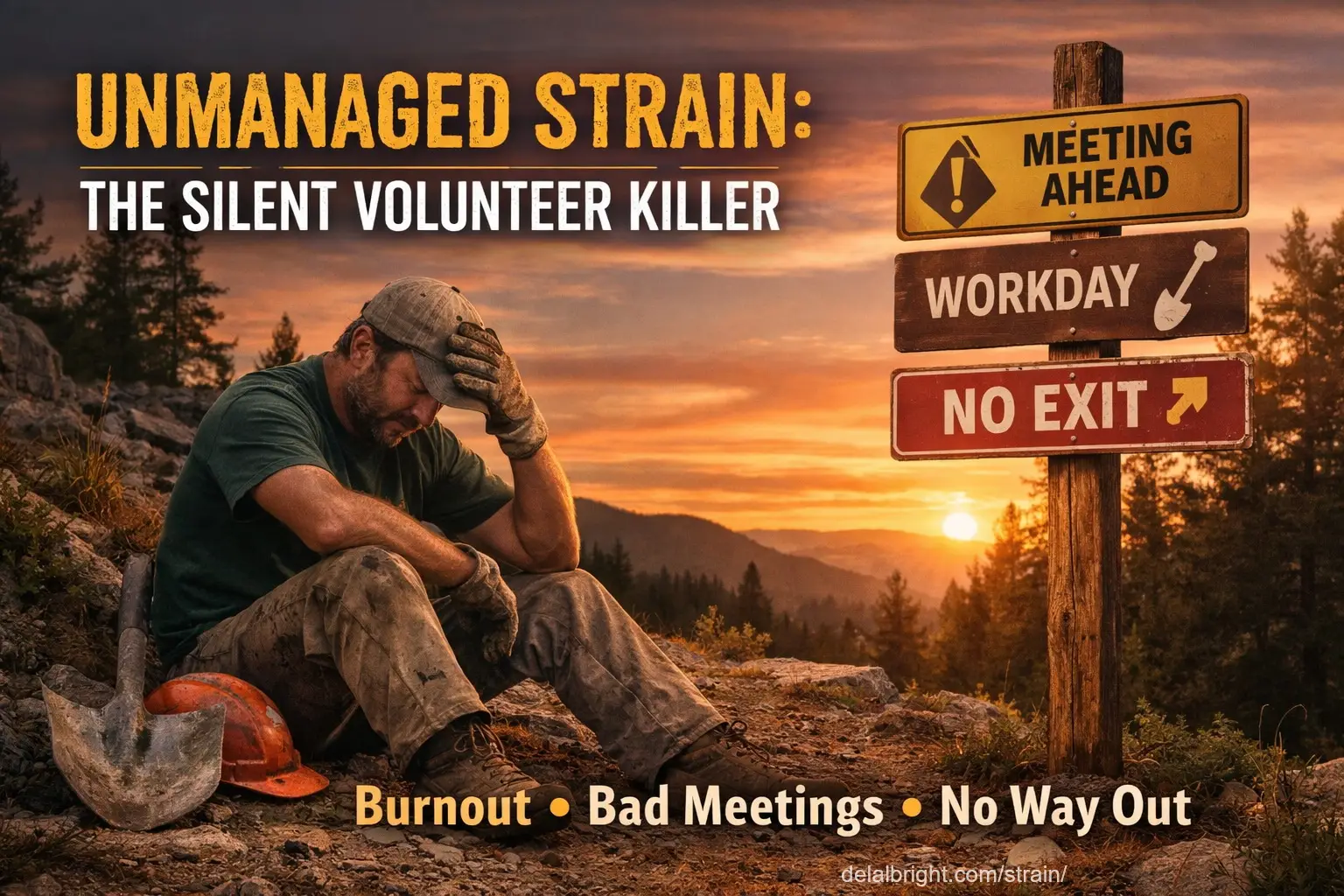
Unmanaged Strain: The Silent Volunteer Killer
By Del Albright
Volunteer organizations rarely collapse in a dramatic moment. They erode quietly. Sometimes if feels like something just “slipped away” or went absent. We sit and wonder how a once-powerful group fades into la-la land and no longer holds a place in the info-relevance landscape.
A key reason is something my good friend Jeff Knoll (King of the Hammers Co-Founder) recently put into words with striking clarity:
“Unmanaged strain degrades judgment, creativity, and output long before it shows up in attrition numbers.”
— Jeff Knoll
That single sentence explains what many of us in recreation, stewardship, and advocacy have witnessed for years—but struggled to clearly name. People don’t usually suddenly quit. They don’t wake up one morning and decide to stop caring. They slowly wear down under unmanaged strain.
And by the time leaders notice the empty chairs, the damage is already done.
What Is “Unmanaged Strain”?
Unmanaged strain doesn’t show up like a tick on a dog about to explode. It may not be red-faced volunteers obviously seething over something. And unmanaged strain is not about how much work volunteers do.
It’s about:
- Accumulated frustration
- Feeling unappreciated or unheard
- Repeated inefficiency
- Poor leadership habits
- Emotional drain without recovery
- Awful meetings poorly run
- Lack of decisions and being heard
Strain becomes destructive when it is:
- Ignored
- Minimized
- Normalized
- Or blamed on the volunteer instead of the system
The most dangerous part? Unmanaged strain doesn’t announce itself.
Where Unmanaged Strain Shows Up
(Hint: Everywhere)
This problem applies equally to:
 Trail Workdays
Confusing instructions
No clear leadership
Poor planning or wasted time
Volunteers standing around wondering why they showed up
No debrief, no thanks, no follow-up
Board Meetings
Long agendas with little purpose
Rehashing old arguments
Dominant personalities controlling outcomes
No clear decisions or action items
Meetings that drain energy instead of focusing it
Clubs
“The same people always do the work”
Elders who won’t let new members lead or learn
Resistance to new ideas
Internal politics replacing mentorship
Criticism replacing coaching
Advocacy Groups
Constant urgency with no pause
Reactive decision-making
Volunteers absorbing public conflict and criticism
Wins rarely celebrated
Losses felt personally and repeatedly
Nonprofits and Committees
Mission creep
Overloaded volunteers wearing multiple hats
Poor supervision or unclear expectations
Passion mistaken for unlimited capacity
Burnout framed as a personal failure
Different settings. Same problem.
Why Leaders Miss It
Leaders often look for strain in the wrong place.
They watch:
Attendance numbers
Membership renewals
Volunteer hours logged
But unmanaged strain shows up earlier as:
Short tempers
Loss of creativity
Reduced initiative
Quiet disengagement
“Just doing the minimum”
By the time attrition shows up in spreadsheets, the organization has already lost momentum—and often trust.
Criticism vs. Constructive Critique
One of the fastest ways to accelerate unmanaged strain is confusing criticism with coaching.
Criticism points out what’s wrong
Critique helps someone get better
Volunteers will tolerate mistakes. They will not tolerate humiliation, dismissal, or constant second-guessing. If people feel judged rather than supported, strain compounds quickly.
The Cost of Not Letting New People Lead
Another common source of unmanaged strain is when long-time leaders refuse to step back.
Experience matters. But so does succession.
When new volunteers:
Never get real responsibility
Are corrected instead of coached
Are told “that’s not how we do it here”
They don’t just disengage—they leave. Organizations that fail to transfer trust eventually lose both energy and institutional knowledge.
Managing Strain Is a Leadership Responsibility
Unmanaged strain is not a volunteer weakness. It is a leadership blind spot.
Healthy organizations:
Plan workdays with intention
Run meetings with purpose
Thank volunteers often and sincerely
Create safe space for learning and failure
Rotate responsibility and authority
Pay attention to morale—not just metrics
Managing strain doesn’t mean lowering standards. It means respecting people enough to protect their capacity.
A Sustainable Volunteer Culture
If we want sustainable trails, access, advocacy, and organizations, we must also build sustainable volunteer systems.
That starts by recognizing this truth:
Strain that goes unmanaged will always surface later—usually when it’s hardest to fix.
The solution isn’t more pressure. It’s better leadership, better structure, and better care for the people who show up.
Because volunteers don’t burn out overnight. They burn down slowly—when no one is watching. Let’s all do our part to fix that and not let unmanaged strain close trails and push away good volunteers.
— Del Albright
👏Read more from Jeff Knoll on LinkedIn.