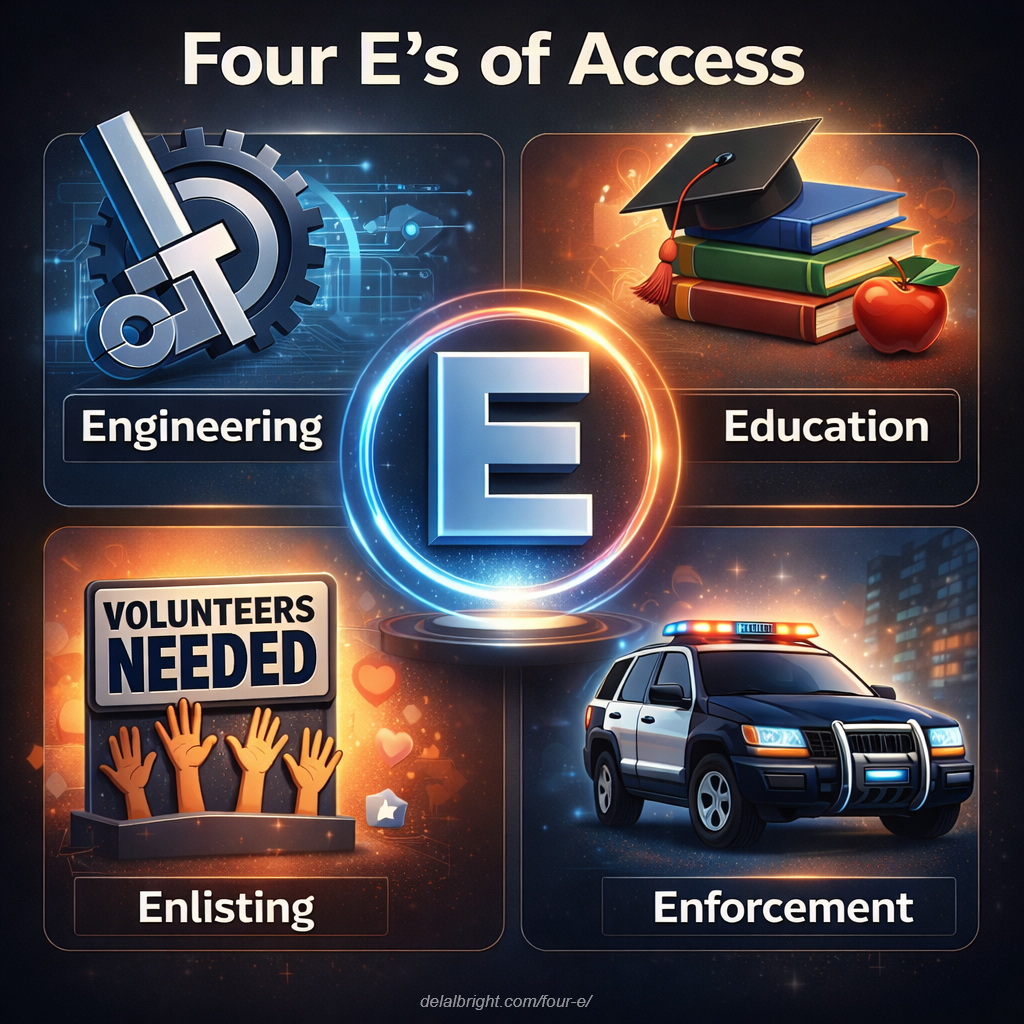
Protecting trail access, sustaining trail systems, and keeping off-pavement motorized recreation alive doesn’t happen by accident. It comes down to a proven, repeatable formula of the Four E’s:
Engineering • Education • Enlisting • Enforcement
In its simplest form, that means:
-
- Design it right
-
- Teach people the rules—and the reasons behind them
-
- Get broad, meaningful involvement
-
- Ensure the rules are followed
This approach isn’t theoretical. It’s been proven for decades in another high-stakes field: fire prevention.
Borrowing from Fire Prevention Success
Across the country, fire services rely on the well-known “Three E’s” of prevention:
-
- Engineering – Designing buildings, communities, and infrastructure to reduce risk
-
- Education – Teaching the public how to prevent fires
-
- Enforcement – Holding people accountable when rules are ignored
In fire prevention, we engineer safer structures, educate through signs, programs, and outreach, and—when necessary—enforce compliance to protect lives and property.
Trail access works the same way—with one critical addition.
The Fourth “E”: Enlisting
To protect trail systems, we must add a fourth pillar:
Enlisting – Actively engaging volunteers, agencies, users, and businesses
Land managers frequently say, “We don’t have the staff to maintain these trails.”
That’s where volunteers step in.
Through organized volunteerism, trail users become the workforce—adopting trails, maintaining routes, monitoring conditions, and building partnerships that make long-term access possible. But this level of involvement does not happen on its own. It must be invited, structured, and supported.
Below are the key components of this four-part formula that you can apply to your own efforts to protect access.
Engineering
Designing trails to last
-
- Risk management assessments
-
- Water control and runoff management
-
- Hardened water crossings
-
- Soil stability evaluation
-
- Rolling dips, water bars, and erosion/sediment control
-
- Gabions and rock structures to strengthen trail surfaces
-
- Vegetation as a soil-stabilizing factor
-
- Proper grade, slope, and in-slope/out-slope design
-
- Addressing rider conflicts and user needs
-
- Complete inventory of routes and trails
-
- Loop trails and roads where feasible
-
- Ongoing monitoring and data collection to meet agency requirements and guide future decisions
Education
Teaching responsibility and stewardship
-
- Clear signage to communicate rules and reinforce “Stay the Trail,” “Leave No Trace,” ethics
-
- Brochures and handouts (tap into programs like Tread Lightly!®, RIDE ON, and similar efforts)
-
- Check-in systems, kiosks, and permits where appropriate
-
- Web pages, forums, and user meetings as needed
-
- Development and sharing of trail codes of ethics
-
- Trail meetings and training sessions focused on education and awareness
Enlisting
Building ownership through involvement and engagement
-
- Recruiting volunteers from users, agencies, and businesses
-
- Volunteer training to ensure leadership, safety, and efficiency
-
- Ongoing leadership development
-
- Adopt-a-Trail programs with agencies and landowners
-
- Organized, segmented trail layouts for easier adoption and maintenance
-
- Public recognition and publication of volunteer efforts
-
- Grant applications that leverage documented volunteer hours
-
- Developing advocacy skills within volunteer ranks
- Making volunteers feel like they’re part of something – part of “owning” the efforts to save the trail
Enforcement
Ensuring the rules matter
-
- Grants to support law enforcement officers or trail security
-
- Clearly posted and visible rules
-
- Warning systems before penalties
-
- Well-publicized enforcement efforts
-
- Volunteer trail patrol programs
-
- Publication of enforcement successes when appropriate
Learn From What Already Works
I strongly encourage you to connect with national, regional, and state associations and study/learn from past successes. Many versions of this formula are already in use—and adapting proven models is often more effective than starting from scratch, but if you remember the Four E’s, you can’t go wrong. This system is precisely what I used to start the efforts to save the Rubicon Trail in 2001.
A Sustainable Trail Future
If you apply these elements—Engineering, Education, Enlisting, and Enforcement—to protecting access, my decades in land use advocacy and the fire service tell me one thing is certain:
We will all have a stronger, safer, and more sustainable trail future.
— Del Albright
Get Involved – learn more here.
Learn the tips and tricks for creating a sustainable future for motorized recreation.
BE SURE to sign up to get notified when my new book, Field Guide to Responsible Outdoor Recreation, gets published.
LEARN from Del’s book on landuse.