
Access Fatigue Comes in Many Forms – and Can Be Avoided
If you’ve been involved in land-use advocacy for any length of time, you’ve probably felt it and might be fed up with it:
Another email.
Another “urgent” call to action.
Another letter to write.
Another deadline.
And all of it lands on top of real life with the rising cost of living, gas prices that make every trip feel heavier, and grocery bills that don’t quit climbing. And let’s not forget national politics that feel nonstop and exhausting, as well as scandals, crises, and noise coming from every direction.
Some of the noise is intentional—it overwhelms, distracts, and drains focus. And when people disengage, the work doesn’t stop; it simply moves on with decisions being made without them.
At some point, it’s natural to think:
“I just want to go have fun. I don’t want to deal with another action item.”
You’re not weak for feeling that way. You’re human. Some writers call this “outrage fatigue.” That’s not the lane I want to be in. Most people in the access community aren’t outraged—they’re tired.
We’re dealing with Access Fatigue.
Or Action Fatigue.
Or CTA Fatigue.
Whatever you call it, it’s real—and pretending it doesn’t exist only drives people away.
The Risk of Tuning Out Completely
The hard truth we can’t ignore is that If good people disengage completely, the decisions don’t stop. They just get made without us.
Access is rarely lost in one dramatic moment. It’s chipped away through silence, absence, and low participation. So the goal isn’t to shame people into action. The goal is to help them stay in the game without burning out.
Motivated—not agitated.
A Healthier Way to Stay Engaged – Some Solutions to Access Fatigue
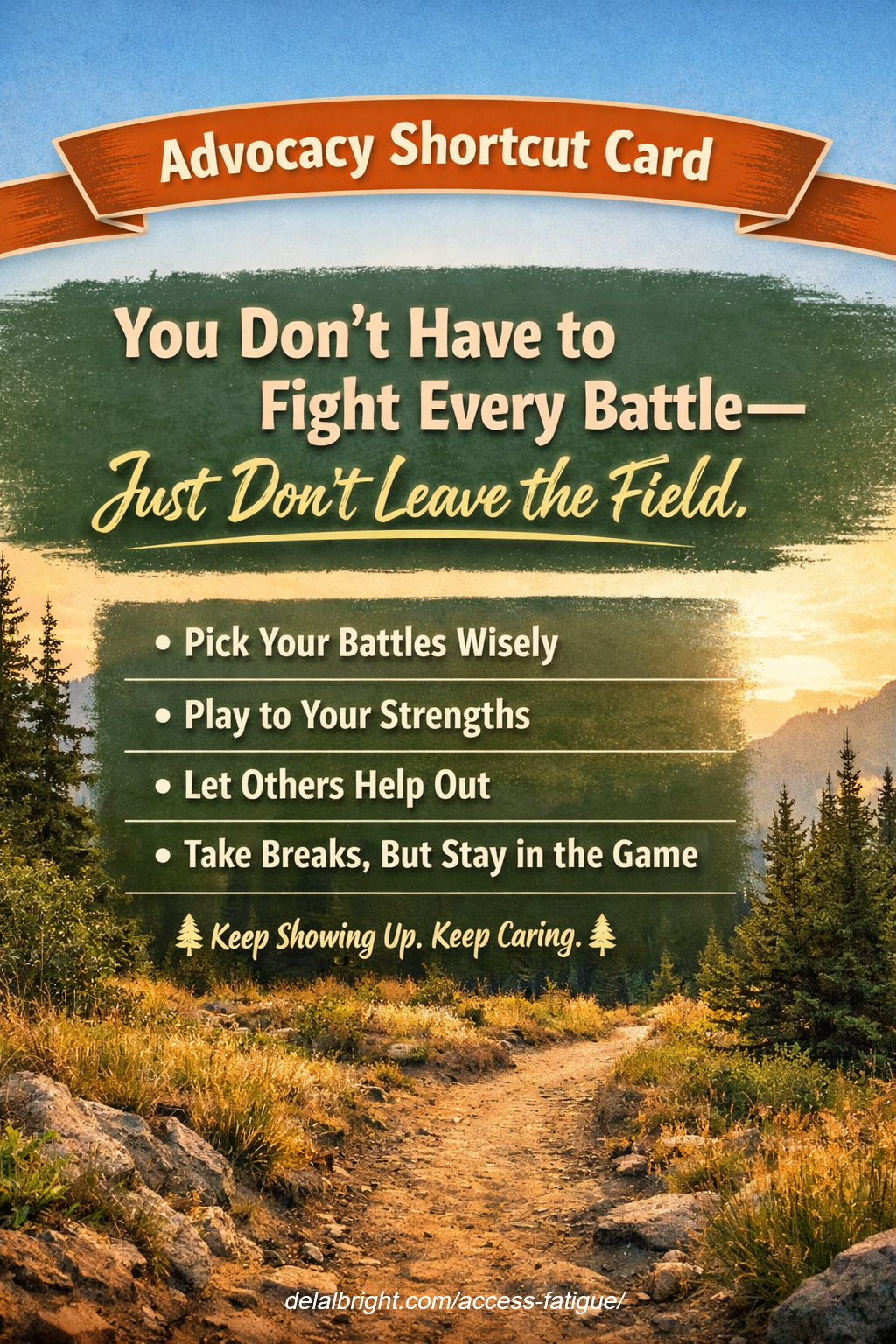
- Pick Your Battles
You don’t have to fight all of them. Not every issue warrants the same level of energy from you. Some actions are mission-critical. Some are important, but not yours to carry. And some can honestly slide—as long as someone else is stepping up.
The key is being intentional, not absent. If you’ve committed to helping on something—follow through. If you haven’t—don’t feel guilty about letting it go. Too much on your plate and your fatigue turns to burnout.
Burnout helps no one.
- Know Your Strengths—and Use Them
Not everyone contributes the same way, and that’s okay.
Ask yourself:
- Are you good at writing letters?
- Do phone calls feel easier?
- Are you better at sharing alerts so others can act?
- Do you show up best in meetings, trail workdays, or conversations?
There is no “one right way” to support access. Do what fits your energy and skill set, and let the rest slide without guilt.
- Don’t Leave People Hanging
This part matters. If a group, leader, or organization is counting on you—and you need to step back—say so. Silence hurts trust, yet honesty preserves it.
A simple:
“I can’t take this one on, but I hope others can.”
goes a long way.
- Take Breaks—But Don’t Quit
Stepping back is not the same as giving up.
Take a weekend off.
Go ride.
Go camp.
Reconnect with why access matters in the first place.
Then come back refreshed—not resentful. Advocacy is a long game, and nobody carries it every day forever.
Why Staying Engaged Still Matters
In the world of access, stewardship, and conservation, letters still matter. Public comments still matter. So, don’t just shy away completely from letters. Also, participation still matters.
Even when it feels repetitive.
Even when it feels slow.
Even when you’re tired.
The people working against motorized access don’t stop because they’re fatigued. And the truth is—we don’t need everyone doing everything. We just need enough people doing something, consistently, over time.
Closing Thoughts: Motivated, Not Agitated
If you’re feeling worn down, you’re not alone. It’s a busy world out there and if you’re frustrated with all the distractions and actions, that makes sense. If you need to step back a bit—that’s healthy. Just don’t disappear.
Stay connected.
Stay selective.
Stay honest.
Stay engaged in a way that fits your life.
Because access is protected by steady, thoughtful participation—from people who care enough to stay in the game.

